What to check before choosing an industrial oven for a bakery

Every baker knows: the smell coming from the oven is the heart of the bakery. It is there that the experience that every customer remembers is created: bread crispy on the outside and soft on the inside, cakes or sweet pastries that attract people from outside. An industrial oven is not just technical equipment, but the heart of the business. In order for the pastries to come out exactly as you want, it is worth choosing wisely the oven that will accompany you for years. Therefore, before purchasing, it is important to understand what you really need to check.

Size and volume of work

The first step is to ask yourself: How much do you plan to bake per day? Industrial bakery ovens come in a variety of sizes, and every business needs a solution that fits the scale of its operations. A small neighborhood bakery will often be satisfied with one large industrial oven that can hold several pans at once, while a manufacturing plant will need several ovens designed for continuous baking. Choosing the right one will ensure that you don’t waste space or money on an oven that’s too big, nor will you find yourself working under unnecessary strain.

Oven type and suitability for products

There are different types of ovens: thin-bottom ovens, combi ovens, deck ovens, and continuous ovens. Each one is suitable for a different type of baked goods. For example, a deck oven is excellent for baking traditional breads thanks to its even heat distribution, while a combi oven allows for flexibility and working with moisture, which is suitable for cakes and pastries. Choosing the wrong one can result in products that do not come out with the desired quality, even if the recipe is perfect. A thin-bottom oven is particularly suitable for pizzas and flat pastries that require high and short heat, while a continuous oven is designed for large production plants that need continuous and fast baking. Therefore, it is recommended to think in advance about the products you are baking and choose the most suitable oven.

Ease of use and operation

Beyond technology, it is important that the oven is suitable for daily work. A large industrial oven should be simple to operate, with a convenient and clear interface, so that even new employees can use it without difficulty. Don’t forget about cleaning and maintenance: removable doors, easy-to-remove trays and self-cleaning mechanisms can save a lot of time and hard work. An oven that is easy to operate will allow you to focus on baking, not maintenance.

Energy efficiency and cost savings

An oven is one of the largest consumers of electricity or gas in a bakery. An industrial oven for bakeries built with advanced technology knows how to maintain a stable temperature while consuming reduced energy. This is not only good for the environment, but also saves a lot of money over time. Modern ovens include high-quality insulation, smart control systems, and efficient use of energy. These are all details worth paying attention to when choosing.

Service and warranty

An oven is a long-term investment, so it’s important to know who stands behind it. A reliable supplier that provides a warranty, training, and available technical service makes all the difference. In the event of a malfunction, you need to be sure that someone will arrive quickly and get the oven back up and running. Furthermore, it’s worth checking whether the company provides original and available spare parts, and if there is a team of technicians who are familiar with the equipment. Such a combination ensures that your investment will continue to serve you for years, without surprises.
Choosing an oven for a bakery is a decision that affects the entire production process. A carefully selected industrial oven not only upgrades the quality of baking, but also saves time, money and resources over time. If you are planning to upgrade or start a bakery, now is the time to make the right choice. With us you will find a variety of industrial ovens from the world’s leading companies, along with professional advice. Contact us today or leave your details in the form and we will be happy to help you find the exact oven that will suit your bakery.
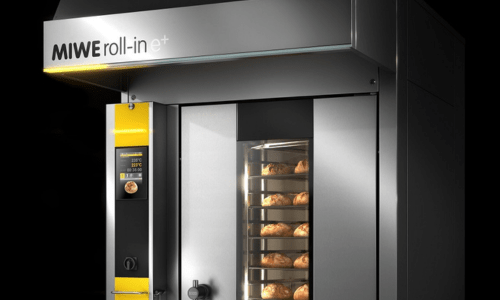
For those looking for bottom lines because the oven is beeping:
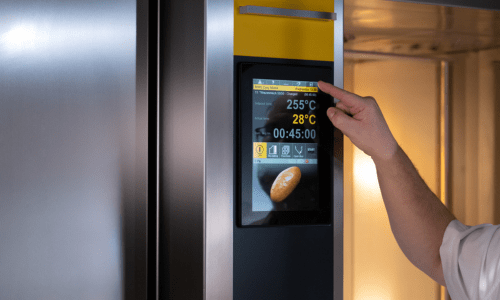
Baking with controlled air technology saves energy, affects the excellent taste, optimizes the work and can be controlled remotely. You are invited to get to know the MIWE IN ROLL oven.

So what is air control and what is it used for?
A short lesson on energy:

The amount of air circulating in the cycle and passing over the baked product has an immediate effect on the baking results .
The physical background for this reason is also easy to understand – above all it is known that two parameters are responsible for transferring the energy from the air to the product:
The air temperature (and for a more focused definition – the difference in temperature between the air temperature and the product temperature) and the amount (or speed) of the swirling air over the product.

The two parameters determine each other. At a warmer air temperature, the amount of air can be reduced by transferring the same amount of energy to the product. On the other hand, if more air is swirling – you can settle for a lower air temperature, and still transfer the same amount of energy to the product.

In fact, in the baking process it is quite clear that there are limitations. Of course, you cannot increase the amount of air as much as you want (and of course you cannot lower the baking temperature without limit), without disrupting the baking processes.

So after we learned about temperature…

What are the advantages of controlling the air flow in the oven?

Various advantages will be available to the baker if he can control the amount of air separately from the control of the baking temperature. The physical process described does work well in baking many products.

Reducing the baking time while increasing the amount of air in the oven, which enables energy savings

Each baked product has its own parameters regarding heat conductivity and volume/weight ratios. That is, if we study the product features in depth, it seems that each product requires its own amount of air and temperature level.

There is an ideal combination of the amount of air and the temperature in each baking oven (due to the different climate conditions), in each baking process, in different seasons and at different points in the world. It is clear to every baker that a lower temperature (or gentler baking) is required as the product is rich in fats and proteins.

On the other hand, the actual improvement that can be achieved as a result of this ideal combination, instead of the conventional method of controlling the temperature alone, is most impressive in different types of pastry, such as yeast cakes, cakes in chuss or cakes in a mold, where the quality of the final product is affected in a positive and visible way when varying amounts of air.

Controlling the amount of air in the oven can also compensate for changes in the baking result caused seasonally due to weather changes, humidity and more. For example: the relative humidity is completely different in summer and winter. In the summer, crispness problems can arise due to low humidity. If we bake in the summer with a greater amount of air in the third and last stage of baking, we can stabilize the crispiness.

The Air control method

The amount of air is controlled by an electric valve (sliding door) located between the combustion chamber and the baking chamber. This valve, which can work for years without problems, regulates the air flow and thus determines the amount of air flowing in the oven.

This valve also closes automatically and without delay in two additional cases to save energy: during steam activation and when opening a door. When steam is injected into the oven, the heating system is completely sealed and separated from the baking chamber into which the large amount of steam is injected. Only after the effect of the steam does the valve return to its place according to the baking program. As a result, the steam does not pass through the combustion chamber, which prevents the cooling of the oven due to the steam at least by 10º – as was the case in the past in ovens with speed controllers and in all conventional ovens, in which it was necessary to start the baking process at a higher temperature.

According to Miwa engineers’ calculations, it is possible to save up to 10% in energy costs as a result of this method, and in addition – the lifespan of the combustion cells has been especially extended.

And in case of a malfunction in the valve, you can easily open it manually and continue baking. Also, since the steam must fill only the baking chamber and not the combustion chamber (as in conventional ovens), a higher amount of steam is created than the same amount of water, and of course in less time and less maintenance costs in the future.

And the other advantage of the method is the possibility to flow up to 1/3 more air into the oven when needed beyond the amount that could be flowed with the speed controllers.

Share if you liked it!